Showing posts with label science. Show all posts

Friday, April 10, 2020

Earth Day


The publication of Rachel Carson’s New York Times bestseller “Silent Spring” in 1962 launched public awareness and concern for living organisms, the environment and the inextricable links between pollution and public health. For the next 8 years, momentum built, culminating in the first Earth Day on April 22, 1970. By the end of 1970, that first Earth Day led to the creation of the United States Environmental Protection Agency and the passage of the Clean Air, Clean Water and Endangered Species Acts.

Earth Day’s fight for environmental awareness went global in 1990 and has been a powerful movement ever since, widely recognized as the largest secular observance in the world and marked by more than a billion people every year as a day of action to change human behavior and provoke policy changes.

On April 22 this year, the world will be celebrating 50 years of Earth Day and its empowering of individuals with the information, the tools, the messaging and the communities needed to make an impact and drive change (https://www.earthday.org/)

Here are a few ways your library card can help you bridge the (social) distance for a celebration at home!

Streaming activities, story times, a message from astronauts aboard the International Space Station, and more can be found here, courtesy of Starnet Libraries!

What's in Store for Ebooks? | American Libraries Magazine
A wealth of ebooks and downloadable audiobooks are available on a variety of ecological topics.  Click here for a selection highlighting the effect of humans on nature.  If you’re interested in another topic or a specific title, search the catalog and use the refining selections for narrowing to available digital formats.

All Kinds of Hoopla Going on at the Library - and Kanopy, Too ...
There are over 700 streaming videos about Earth available through Hoopla and Kanopy (access online at www.eolib.org or download from your app store). Click here to view the list. Hoopla and Kanopy have limited service areas depending upon residency.  Check with your local library to be sure.

Flipster Digital Magazines | St. Louis County Library
Get some gardening tips form HGTV Magazine, Southern Living, or Better Homes & Gardens and check out the latest issue of National Geographic to travel the globe from the comfort of home with Flipster, our digital magazine service. You can access it from our website or download from your app store.

GreenFILE | BadgerLink
Need more in-depth research for a school project. EBSCO’s free GreenFILE database has you covered. Find it in the Health/Science section of the Jefferson County Library Cooperative’s databases.

Universal Class | Timberland Regional Library
Brush up on your outdoor skills with classes in gardening, ecology, bird watching, wildlife rehabilitation, and more on Universal Class, accessible via our website.

Hiking - Blue Ridge Parkway (U.S. National Park Service)
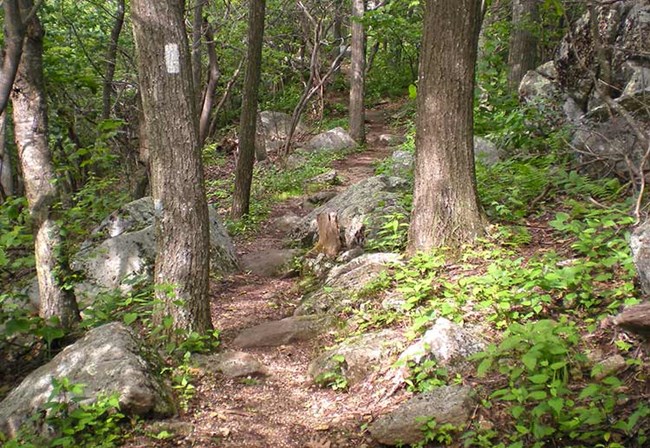
Get out into nature the best way you can!  Here are a few options:


Oceans Initiative Marine Biology Camp (live on Instagram at 1pm CDT Monday and Thursday)

Wednesday, March 27, 2019

technology and invention


Upcoming April Highlights

Online registration at www.eolib.org opens Monday, April 1st for an encore performance of Dolores Hydock and Bobby Hortons “A Sweet Strangeness Fills My Heart” to be held on Sunday, May 5th, doors at 2pm with the show starting at 2:30pm. Be sure to include an email or phone number.

Gentle Yoga with Marie Blair happens each Tuesday morning in April at 10am. Please bring a mat.

The Brown Bag Lunch Series is each Wednesday at 12:30pm. Bring a sack lunch and we’ll provide beverages and dessert.

Tuesday, April 2nd at 6:30pm – Dr. Stephanie Yates will present “10 Smart Money Habits for 2019”

Thursday, April 4th at 10am – Meditation & Mindfulness Workshop with Kathy Hagood

Thursday, April 11th at 10am – Meditation & Mindfulness Workshop with Kathy Hagood

Thursday, April 11th at 6:30pm – UAB Neuroscience CafĂ©: Fighting Brain Tumors

Saturday, April 13th 1-4pm – Online registration required at www.eolib.org for Craft Academy: Cyanotype Printing

Tuesday, April 16th at 6:30pm – Documentaries After Dark: NY Time obituary writers

Tuesday, April 30th at 6:30pm – Genre Reading Group: Literature in Translation

_________________

This week, the Genre Reading Group met to discuss technology and invention.

Image result for valley of genius adam fisher

Rarely has one economy asserted itself as swiftly--and as aggressively--as the entity we now know as Silicon Valley. Built with a seemingly permanent culture of reinvention, Silicon Valley does not fight change; it embraces it, and now powers the American economy and global innovation.

So how did this omnipotent and ever-morphing place come to be? It was not by planning. It was, like many an empire before it, part luck, part timing, and part ambition. And part pure, unbridled genius...

Drawing on over two hundred in-depth interviews, VALLEY OF GENIUS takes readers from the dawn of the personal computer and the internet, through the heyday of the web, up to the very moment when our current technological reality was invented. It interweaves accounts of invention and betrayal, overnight success and underground exploits, to tell the story of Silicon Valley like it has never been told before. Read it to discover the stories that Valley insiders tell each other: the tall tales that are all, improbably, true.

Image result for art of invisibility mitnick

Your every step online is being tracked and stored, and your identity literally stolen. Big companies and big governments want to know and exploit what you do, and privacy is a luxury few can afford or understand.

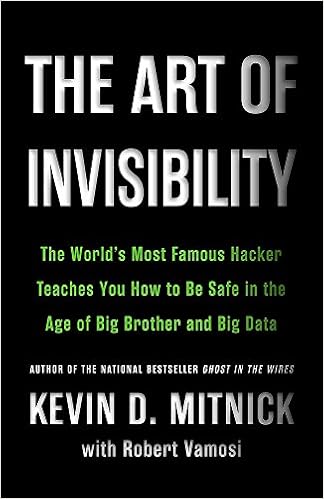
In this explosive yet practical book, Kevin Mitnick uses true-life stories to show exactly what is happening without your knowledge, teaching you "the art of invisibility"--online and real-world tactics to protect you and your family, using easy step-by-step instructions. Reading this book, you will learn everything from password protection and smart Wi-Fi usage to advanced techniques designed to maximize your anonymity. 

Kevin Mitnick knows exactly how vulnerabilities can be exploited and just what to do to prevent that from happening. The world's most famous--and formerly the US government's most wanted--computer hacker, he has hacked into some of the country's most powerful and seemingly impenetrable agencies and companies, and at one point was on a three-year run from the FBI. Now Mitnick is reformed and widely regarded as the expert on the subject of computer security. 

Invisibility isn't just for superheroes--privacy is a power you deserve and need in the age of Big Brother and Big Data. 

Image result for the economist
We are placing increasing importance on numbers: Fitbit, student performance, car insurance trackers, employee productivity...the list goes on and on. The Economist reviews the book "The Metric Society" in the “Every Step You Take” article

Image result for american firsts stephen spignesi

What would the world be like without all that the United States-in just over two short centuries-has achieved, invented, accomplished, and shared? The "invention" known as the United States of America has been the most influential force in the history of civilization. Now is the time to celebrate it! American Firsts offers an alluring, amusing, and amazing look at the creation and use of a wide range of American innovations, from agriculture to transportation, and everything in between. It's time for Americans to be proud of the wonders they have given the world.

Image result for death rays barry parker

James Bond would have died a thousand deaths if not for Q, the genius behind the pen grenades and weaponized sports cars that have helped Britain's most famous secret agent cheat death in twenty films. Here Barry Parker demonstrates how science and technology have been as important to 007 as good looks, shaken martinis, and beautiful women.
Using entertaining sketches and nontechnical language, Parker explains the basic physics behind the gadgets, cars, and stunts in a number of Bond films, from the jet packs in Thunderball to the dynamics of daredevil bungee jumping in GoldenEye.
If you've ever wondered whether the laser could have actually cut Bond in half (Goldfinger), if a wristwatch could really unzip a woman's dress (Live and Let Die), or whether your car could do the 360-degree barrel roll from The Man with the Golden Gun, this book is for you.
Image result for bombshell hedy lamarr

What do the most ravishingly beautiful actress of the 1930s and 40s and the inventor whose concepts were the basis of cell phone and bluetooth technology have in common? They are both Hedy Lamarr, the glamour icon whose ravishing visage was the inspiration for Snow White and Cat Woman and a technological trailblazer who perfected a radio system to throw Nazi torpedoes off course during WWII. Weaving interviews and clips with never-before-heard audio tapes of Hedy speaking on the record about her incredible life—from her beginnings as an Austrian Jewish emigre to her scandalous nude scene in the 1933 film Ecstasy to her glittering Hollywood life to her ground-breaking, but completely uncredited inventions to her latter years when she became a recluse, impoverished and almost forgotten—BOMBSHELL: THE HEDY LAMARR STORY brings to light the story of an unusual and accomplished woman, spurned as too beautiful to be smart, but a role model to this day.

Image result for the toys that made us netflix

The minds behind history's most iconic toy franchises discuss the rise -- and sometimes fall -- of their billion-dollar creations.

Image result for the shallows nicholas carr

Finalist for the 2011 Pulitzer Prize in General Nonfiction: “Nicholas Carr has written a Silent Spring for the literary mind.”―Michael Agger, Slate
“Is Google making us stupid?” When Nicholas Carr posed that question, in a celebrated Atlantic Monthly cover story, he tapped into a well of anxiety about how the Internet is changing us. He also crystallized one of the most important debates of our time: As we enjoy the Net’s bounties, are we sacrificing our ability to read and think deeply?

Now, Carr expands his argument into the most compelling exploration of the Internet’s intellectual and cultural consequences yet published. As he describes how human thought has been shaped through the centuries by “tools of the mind”―from the alphabet to maps, to the printing press, the clock, and the computer―Carr interweaves a fascinating account of recent discoveries in neuroscience by such pioneers as Michael Merzenich and Eric Kandel. Our brains, the historical and scientific evidence reveals, change in response to our experiences. The technologies we use to find, store, and share information can literally reroute our neural pathways.

Building on the insights of thinkers from Plato to McLuhan, Carr makes a convincing case that every information technology carries an intellectual ethic―a set of assumptions about the nature of knowledge and intelligence. He explains how the printed book served to focus our attention, promoting deep and creative thought. In stark contrast, the Internet encourages the rapid, distracted sampling of small bits of information from many sources. Its ethic is that of the industrialist, an ethic of speed and efficiency, of optimized production and consumption―and now the Net is remaking us in its own image. We are becoming ever more adept at scanning and skimming, but what we are losing is our capacity for concentration, contemplation, and reflection.

Part intellectual history, part popular science, and part cultural criticism, The Shallows sparkles with memorable vignettes―Friedrich Nietzsche wrestling with a typewriter, Sigmund Freud dissecting the brains of sea creatures, Nathaniel Hawthorne contemplating the thunderous approach of a steam locomotive―even as it plumbs profound questions about the state of our modern psyche. This is a book that will forever alter the way we think about media and our minds.

Wednesday, February 1, 2017

climate science

Mark your calendars!

--Sunday, February 5th at 2pm, the final film in The Holocaust in Film series, “The People vs. Fritz Bauer"

--Our February GRG meeting is one Tuesday early this month on February 21st at 6:30pm and the topic up for discussion is biographical fiction.  There is a selection of this genre on display at the 2nd floor reference desk.

--The Friends of the Library annual Book Sale is the last weekend of the month.  The invite-only preview party is Thursday, February 23 @ 6pm.  Didn’t receive an invitation?  No worries!  You can join the Friends at the door for a $25 donation.  The sale opens to the public Friday-Saturday, 10am-5pm, and Sunday 1pm-4pm. 

This month, we discussed books on climate science.  The conversation was lively!

Image result for sixth extinction kolbert
WINNER OF THE PULITZER PRIZE
ONE OF THE NEW YORK TIMES BOOK REVIEW'S 10 BEST BOOKS OF THE YEAR
A NEW YORK TIMES BESTSELLER
A NATIONAL BOOK CRITICS CIRCLE AWARD FINALIST

A major book about the future of the world, blending intellectual and natural history and field reporting into a powerful account of the mass extinction unfolding before our eyes.

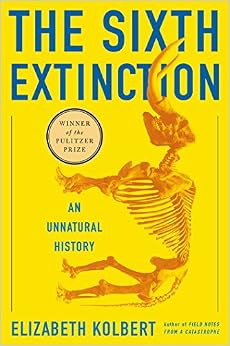
Over the last half-billion years, there have been Five mass extinctions, when the diversity of life on earth suddenly and dramatically contracted. Scientists around the world are currently monitoring the sixth extinction, predicted to be the most devastating extinction event since the asteroid impact that wiped out the dinosaurs. This time around, the cataclysm is us. In prose that is at once frank, entertaining, and deeply informed, New Yorker writer Elizabeth Kolbert tells us why and how human beings have altered life on the planet in a way no species has before. Interweaving research in half a dozen disciplines, descriptions of the fascinating species that have already been lost, and the history of extinction as a concept, Kolbert provides a moving and comprehensive account of the disappearances occurring before our very eyes. She shows that the sixth extinction is likely to be mankind's most lasting legacy, compelling us to rethink the fundamental question of what it means to be human.
Image result for god species lynas
We humans are the God species, both the creators and destroyers of life on this planet. As we enter a new geological era - the Anthropocene - our collective power now overwhelms and dominates the major forces of nature.

But from the water cycle to the circulation of nitrogen and carbon through the entire Earth system, we are coming dangerously close to destroying the planetary life-support systems that sustain us. In this controversial new book, Royal Society Science Books Prize winner Mark Lynas shows us how we must use our new mastery over nature to save the planet from ourselves.

Taking forward the work of a brilliant new group of Earth-system scientists who have mapped out our real 'planetary boundaries', Lynas draws up a radical manifesto calling for the increased use of environmentally-friendly technologies like genetic engi- neering and nuclear power as part of a global effort to use humanity's best tools to protect and nurture the biosphere.

Ecological limits are real, but economic limits are not, Lynas contends. We can and must feed a richer population of nine billion people in decades to come, whilst also respecting the nine planetary boundaries - from biodiversity to ocean acidification - now identified and quantified by scientists.

Ripping up years of environmental orthodoxy, he reveals how the prescriptions of the current green movement are likely to hinder as much as help our vitally-needed effort to use science and technology to play God and save the planet.
Image result for this changes everything naomi klein
The most important book yet from the author of the international bestseller The Shock Doctrine, a brilliant explanation of why the climate crisis challenges us to abandon the core “free market” ideology of our time, restructure the global economy, and remake our political systems.

In short, either we embrace radical change ourselves or radical changes will be visited upon our physical world. The status quo is no longer an option.

In This Changes Everything Naomi Klein argues that climate change isn’t just another issue to be neatly filed between taxes and health care. It’s an alarm that calls us to fix an economic system that is already failing us in many ways. Klein meticulously builds the case for how massively reducing our greenhouse emissions is our best chance to simultaneously reduce gaping inequalities, re-imagine our broken democracies, and rebuild our gutted local economies. She exposes the ideological desperation of the climate-change deniers, the messianic delusions of the would-be geoengineers, and the tragic defeatism of too many mainstream green initiatives. And she demonstrates precisely why the market has not—and cannot—fix the climate crisis but will instead make things worse, with ever more extreme and ecologically damaging extraction methods, accompanied by rampant disaster capitalism.

Klein argues that the changes to our relationship with nature and one another that are required to respond to the climate crisis humanely should not be viewed as grim penance, but rather as a kind of gift—a catalyst to transform broken economic and cultural priorities and to heal long-festering historical wounds. And she documents the inspiring movements that have already begun this process: communities that are not just refusing to be sites of further fossil fuel extraction but are building the next, regeneration-based economies right now.

Can we pull off these changes in time? Nothing is certain. Nothing except that climate change changes everything. And for a very brief time, the nature of that change is still up to us.

Image result for harmony prince charles
Harmony: A New Way of Looking at Our World by Charles HRH The Prince of Wales
For the first time, His Royal Highness Charles, the Prince of Wales, shares his views on how mankind’s most pressing modern challenges are rooted in our disharmony with nature. In the vein of Al Gore’s An Inconvenient Truth and Van Jones’ Green Collar Economy, Prince Charles presents the compelling case that solutions to our most dire crises—from climate change to poverty—lie in regaining a balance with the world around us.

Image result for climate change ladybird expert
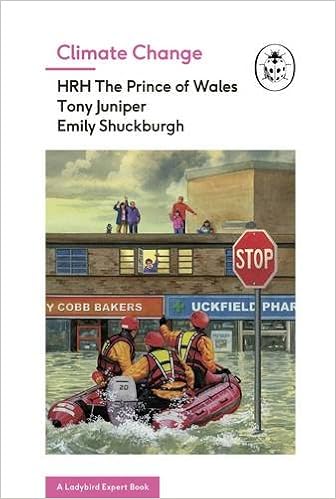
GENERAL DISCUSSION: Prince Charles’ new book, “Climate Change: A Ladybird Expert Book,” came out last month. 
Climate Change is the first book of a new series of titles written for an adult readership and produced in the same iconic small hardback format pioneered by the original Ladybirds.

Written by some of the leading lights and outstanding communicators in their fields, the Ladybird Expert books provide clear, accessible and authoritative introductions, informed by expert opinion, to subjects drawn from science, history and culture.

Image result for silent spring by rachel carson
Silent Spring by Rachel Carson
Rachel Carson’s Silent Spring was first published in three serialized excerpts in the New Yorker in June of 1962. The book appeared in September of that year and the outcry that followed its publication forced the banning of DDT and spurred revolutionary changes in the laws affecting our air, land, and water. Carson’s passionate concern for the future of our planet reverberated powerfully throughout the world, and her eloquent book was instrumental in launching the environmental movement. It is without question one of the landmark books of the twentieth century.  

Image result for global weirdness climate central
Global Weirdness summarizes everything we know about the science of climate change, explains what is likely to happen to the climate in the future, and lays out, in practical terms, what we can do to avoid further shifts. In fifty easy-to-read entries, Climate Central tackles basic questions such as: 

-Is climate ever “normal”?
-Why and how do fossil-fuel burning and other human practices produce greenhouse gases?
-What natural forces have caused climate change in the past?
-What risks does climate change pose for human health?
-What accounts for the diminishment of mountain glaciers and small ice caps around the world since 1850?
-What are the economic costs and benefits of reducing carbon emissions?

Illustrated throughout with clarifying graphics, Global Weirdness enlarges our understanding of how climate change affects our daily lives, and arms us with the incontrovertible facts we need to make informed decisions about the future of the planet, and of humankind.
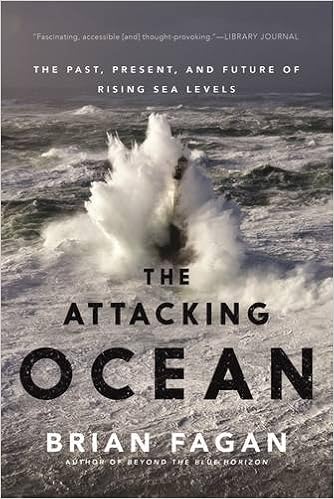
Image result for attacking ocean fagan
The past fifteen thousand years-the entire span of human civilization-have witnessed dramatic sea level changes, which began with rapid global warming at the end of the Ice Age, when coastlines were more than seven hundred feet below modern levels. Over the next ten millennia, the oceans climbed in fits and starts. These rapid changes had little effect on those humans who experienced them, partly because there were so few people on earth, and also because those people were able to adjust readily to new coastlines.

Global sea levels stabilized about six thousand years ago, except for local adjustments that caused often significant changes to places such as the Nile Delta. The curve of inexorably rising seas flattened out as urban civilizations developed in Egypt, Mesopotamia, and South Asia. The earth's population boomed, quintupling from the time of Christ to the Industrial Revolution. The threat from the oceans increased with our crowding along shores to live, fish, and trade.

Since 1860, the world has warmed significantly and the ocean's climb has accelerated. The sea level changes are cumulative and gradual; no one knows when they will end. The Attacking Ocean, from celebrated author Brian Fagan, tells a tale of the rising complexity of the relationship between humans and the sea at their doorsteps, a complexity created not by the oceans, which have changed little. What has changed is us, and the number of us on earth.

Image result for how bad are bananas the carbon footprint of everything
Is it more environmentally friendly to ride the bus or drive a hybrid car? In a public washroom, should you dry your hands with paper towel or use the air dryer? And how bad is it really to eat bananas shipped from South America? Climate change is upon us whether we like it or not. 

Managing our carbon usage has become a part of everyday life and we have no choice but to live in a carbon-careful world. The seriousness of the challenge is getting stronger, demanding that we have a proper understanding of the carbon implications of our everyday lifestyle decisions. However most of us don't have sufficient understanding of carbon emissions to be able to engage in this intelligently. 

Part green-lifestyle guide, part popular science, How Bad Are Bananas? is the first book to provide the information we need to make carbon-savvy purchases and informed lifestyle choices, and to build carbon considerations into our everyday thinking. It also helps put our decisions into perspective with entries for the big things (the World Cup, volcanic eruptions, and the Iraq war) as well as the small (email, ironing a shirt, a glass of beer). And it covers the range from birth (the carbon footprint of having a child) to death (the carbon impact of cremation). Packed full of surprises-a plastic bag has the smallest footprint of any item listed, while a block of cheese is bad news-the book continuously informs, delights, and engages the reader. 

Highly accessible and entertaining, solidly researched and referenced, packed full of easily digestible figures, catchy statistics, and informative charts and graphs, How Bad Are Bananas? is doesn't tell people what to do, but it will raise awareness, encourage discussion, and help people to make up their own minds based on their own priorities.

Image result for gretel ehrlich
Rotten Ice: Traveling by Dogsled in the Melting Arctic by Gretel Ehrlich (Harper’s: April 2015 issue)
Since 1993, Gretel Ehrlich has made several trips to northwestern Greenland, more than 500 miles above the Arctic Circle.  There, she formed friendships with Inuit subsistence hunters in Qaanaaq with whom she lived and hunted on sea ice for months at a time.

Image result for take it from me brockovich

Erin was a divorced mother struggling to raise three kids on $800 a month when she set off the investigation that forced a utility company to pay $333 million for leaking a known carcinogen into the water supply of a small California town. She was rewarded with a surprise $2 million dollar bonus for her efforts, but the real pay-offs were the respect she earned, the self-esteem she built, and the knowledge that she could accomplish anything by calling on her inner strength. Thanks to the movie of her David versus Goliath struggle and victory, Brockovich is now famous, but still fighting. She's currently researching numerous new toxicpollution cases. "We're going to make a difference," she says, "I absolutely believe that."  In Take It From Me!, Erin herself provides readers with the motivational strategies and tactics that led her to find her inner strength and teaches readers how to use their own inner strength for amazing success.